


We present a revisiting study of the brown dwarf pair orbiting the naked-eye (V = 3.3) K-giant ν Ophiuchi, located only 44 pc from our solar system. By jointly analysing archival radial-velocity measurements together with astrometric data from Hipparcos and the Gaia second and third data releases, we determine the three-dimensional architecture of the system and robustly constrain the masses of both companions. We find brown dwarf masses of  and
and  . The mathematical constraint, derived from the posterior distribution of the mutual inclination based on Markov Chain Monte Carlo samples, yields a mutual inclination of
 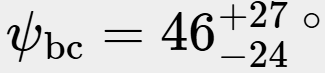 , while direct calculations based on the maximum a posteriori and posterior median orbital parameters yield values of ∼10° and ∼20°, respectively. Resonance analysis indicates that the two companions can still be trapped in a 6:1 mean-motion resonance in the maximum a posteriori configuration. To place an upper limit for the mutual inclination, dynamical stability analysis over a 1 Myr timescale further constrains it to be no larger than ∼15°. Systems hosting brown dwarf pairs are rare, yet they provide important constraints on theories of planetary formation and dynamical evolution. Current detections suggest that brown dwarf pairs preferentially reside at large separations from their host stars and are more common in less mature systems. This supports a star-like formation pathway via gravitational instability in disk.
techniques: radial velocities – astrometry – stars: individual (ν Ophiuchi)
There are currently no refbacks.

It accepts original submissions from all over the world and is internationally published and distributed by IOP